

Three data centre projects in three states, with three differing power plans expose standards issues
Published Date : 2026-August-27, Thursday
Yesterday's national cabinet meeting of the prime minister, premiers and chief ministers, at which plans to impose national data centre standards were discussed, was expected to be fiery.
Leading up to the meeting two states, the Northern Territory and Queensland, had publicly dissented with the federal government’s proposed guidelines, in particular mandating renewable energy to power new data centres.
After the meeting all sides claimed a “win”, with the NT Chief Minister Lia Finocchiaro saying that “Nationally consistent regulation of data centres will go ahead, with full recognition that the Territory’s position on energy is uniquely different to the other states".
Queensland also signed on indicating that the PM had given ground in relation to mandating renewable energy supply.
There will be plenty of analysis about the meeting's policy implications, but what's happening at the planning level in terms of power supply for proposed data centres that is creating this rift between federal and (some) state ambitions?
AltEnergy looked at three high-profile cases that are currently making news.
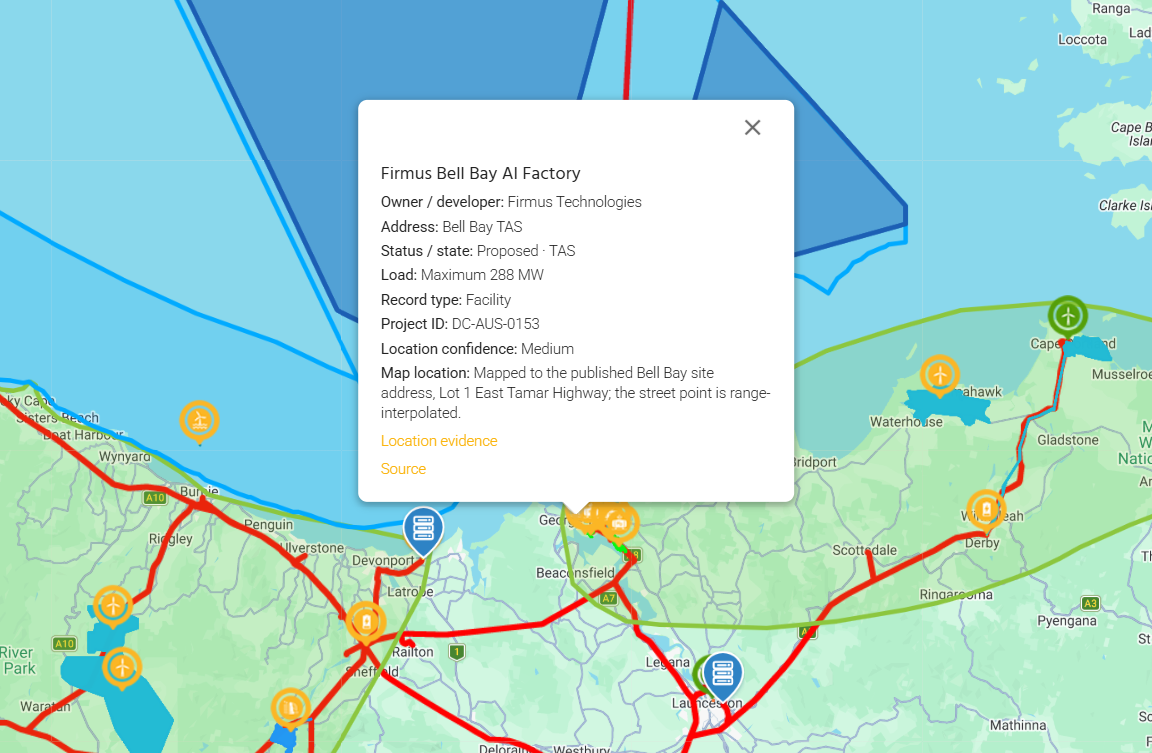
Tasmania’s George Town Council this week approved Firmus Technologies’ 288 MW Bell Bay AI Factory data centre, to be built on the former Gunns pulp mill site at Long Reach.
Firmus said its Bell Bay site will draw power from the grid, “which in turn is fed largely by hydro, wind, and solar power — just like other major industries in the Bell Bay region”.
A new sub-station will be constructed so the project can directly connect to three 220kV TasNetworks transmission lines that run through the site, with no impact on residential supply.
Firmus also points out it “is also supporting new renewable energy projects in Tasmania to offset the site’s electricity use over time”.
Firmus has shown its willingness to back new renewable energy generation, in June signing a 12-year wholesale energy supply agreement with Gunvor Group for 600 MW of firm electricity to support the next phase of its Project Southgate.
The agreement was targeted to supply Firmus’s planned South Australian expansion, and included a long-term offtake supporting GreenPoint Energy’s 200 MW / 800 MWh Koolunga BESS.
Another new data centre project that has attracted attention recently is Zerra DC's proposed Western Downs Digital Park (WDDP) near Dalby in Queensland.
Singapore-based data centre developer Zerra DC is planning a 1.44GW campus, built in four stages of 360 MW each, on a 725.5-hectare site around 37km north-west of Dalby.
Zerra DC said WDDP will connect directly to the high-voltage transmission network at the existing Braemar sub-station, and it will fund the dedicated connection infrastructure required.
Zerra intends to provide power to the project in a way that “avoids adverse impacts on consumer power prices”, including “supporting the contracting and development of new renewable generation and firming capacity in Queensland as the project grows”.
So, initially at least, it appears WDDP will be pulling from the grid without supporting any new additional renewable energy.
Which is definitely the case with the third planned data centre we are looking at, Beetaloo Energy’s proposed integrated AI project at Waddell in the Northern Territory.
Beetaloo this week signed an MOU with Australian Gas Infrastructure Group (AGIG) to study an approximate 750km gas pipeline to connect its Carpentaria Gas project resource to the Darwin area.
More specifically the parties will jointly assess requirements to support the proposed Beetaloo Digital Data Centre development with up to 2GW of gas-fired on-site power generation, on 185ha of land in Wadell which the NT Government awarded exclusivity over.
Three data centre proposals in different states and with different electricity supply arrangements highlight the complexity involved in power supply, and the difficult task the federal government faces in terms of national regulation.