

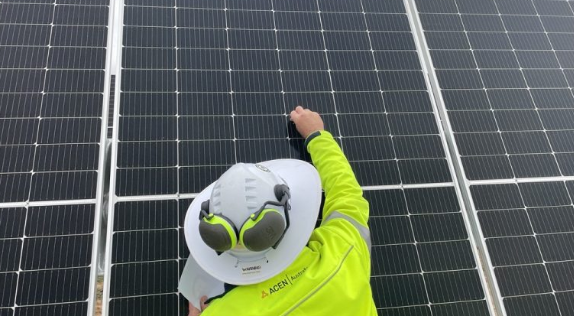
The backstory with CPVA's Laura Jones
Published Date : 2025-December-2, Tuesday
Circular PV Alliance (CPVA) recently certified ACEN Australia’s 400MW Stubbo Solar Farm under the CPVA Certified™ program, meaning almost 1 million solar panels from the regional NSW based project will be recycled at their end of life. It was the second project to achieve CPVA Certified status, following on from Climate Capital’s 5 MW Bell Bay Solar Farm in February this year. AltEnergy caught up with CPVA’s Laura Jones to find out more.

1. Congratulations on the Stubbo Solar project signing. How significant is this for CPVA and the CPVA Certified scheme?
Laura: Stubbo
Solar Farm is the first large (greater than 100MW capacity) solar farm
certification and our second ever certification (the first one ever being Bell
Bay solar farm). We are super happy with how it turned out.
We started
building CPVA certified™ in 2024 as a way to “move the needle” on circularity
in solar farms. It’s designed as a practical and pragmatic way to help solar
farm owners build circularity into solar farms in all parts of the solar farm’s
lifecycle. And to get a certification in the process. What I have really
enjoyed is the creativity developers bring to certification. Each time they
find interesting and innovative ways to increase circularity in their
developments. For example, one developer provided some equipment that had been
damaged during construction to neighbouring farmers, giving it a second life
and avoiding waste – pretty neat.
Stubbo really
has been a bit of a game changer for us. It’s a large development and a name
many in the industry know, so when they see Stubbo has a new certification they
look, and that leads them to us. We hope Stubbo is the start of a movement
towards much more circularity for solar developments. Really, we started this
to move the needle, and it feels like we are beginning to see some movement.
Each project
has been different. Bell Bay Solar Farm, our first certification, was critical.
The whole Climate Capital team went all-in and helped us build CPVA Certified™
from the ground up. Stubbo and Acen have given us scale with a much larger
development. I’m excited to see what’s next!
2. It’s the
second project to be certified and a substantially larger one. Does it make any
difference, small-scale or large-scale, to how certification is applied?
Laura: There
are differences between smaller and larger developments. CPVA Certified™ is
implemented as a series of circularity standards that probe different elements
of circularity. They are classified into four groups: planning, procurement,
operations, and decommissioning. Some of the standards are optional, and some
are mandatory. Because smaller developments often have less resources than
larger ones, there are more optional standards for smaller developments.
There are also
different certifications when a solar farm is certified before it is
constructed than after. Some of the standards (particularly those in the
procurement group) make much more sense when applied before major investment
decisions are made. For example, one standard relates to recycled and reused
content. The intent of this standard is to get developers to seek opportunities
to integrate recycled and reused content in their development. One way we
envisage this being done is by including it in tender specifications. But after
the plant has been built it is much harder to retrospectively meet this
standard. Over time we hope more developers will certify their developments
during the planning phase before major equipment decisions have been made.
3. What is
the scale of the future problem we are looking at in terms of panel numbers,
and why do we need to worry about it now?
Laura: The most
credible studies I have seen are a 2024 study by University of NSW that predicts we’ll
be producing over 91,000 tonnes of end of life PV panels per year by 2030. Around 4 million solar panels are
decommissioned each year in Australia currently. We have seen from our work,
many of these solar panels are still functioning. They are often removed for
reasons other than failure such as upgrade, roof replacement, or because other
panels in an array were damaged.
It takes time
to build a vibrant industry. We need to start now if we want service providers
to exist to manage these end of life modules by the time we produce them. One
of the drivers for CPVA Certified™ was to create a “pull factor” to get more
organisations managing end of life solar panels well. When a large solar
developer needs to make agreements early on in the life of their solar plants
with organizations who can manage their end of life panels, it creates some
certainty and helps create investment signals.
Also, CPVA
Certified™ is about more than just end of life. It’s just as important that
developers are customers of the circular economy as well as suppliers. Using
reused and recycled content in their developments is a big part of this. People
will make things that are in demand. If developers start asking for solar
panels with recycled content, recycled steel, etc they will start being made.
Also, keeping things in service for longer is a key part of circular economy. It reduces the level of recycling that we need to do. It’s part of CPVA Certified™ too, we ask solar developers to look for service providers (like maintenance companies) who can keep up with best practice in repair.
We are working
with PVLab and ANU in a project to test a PV panel backsheet repair material.
Backsheet failure is a common failure mode for monofacial solar panels. Showing
that they can be repaired gives impetus and momentum to solar developers to
integrate repair into their plant operations too.
You note I
haven’t said “recyclers” here. Recycling is an important part of the circular
economy, but really recycling should be reserved for things that are broken and
can’t be repaired. Re-use, and repair should be used in preference to
recycling.
4. Does CPVA
Certified provide a level of confidence for developers in terms of social
licence, and confidence for communities where these projects are being built?
Laura: That’s
one of its main value propositions. We have heard from developers and from
first-hand experience that local governments and communities care about end of
life of renewable plant built in their areas. They don’t want renewable
developments to become a waste problem for them in the future. CPVA certified
was designed as a way for developers to publicly show that they are taking
circular economy seriously.
5. Does CPVA
have any other projects in the certification pipeline you can tell us about?
Laura: We have
lots of plans and are meeting with more project developers that are at the
start of exploring circularity and certification for their projects, it’s an
exciting time for CPVA and the industry. There is so much to do to create a
vibrant circular economy for PV. We are a small non-profit so if you want to
see more, join us!
6. With the
proliferation of Battery Energy Storage System projects being developed and
built, is CPVA looking at battery circular management for end of life?
Laura: The Association
for the Battery Recycling Industry has been one of our supporters since day
one. So batteries have been on our mind since we first conceptualised CPVA
certified™. We’re just looking for the first battery developer to say “I’m in”.